


It’s nearly impossible for private equity firms to maintain healthy margins in today’s business landscape without managing their portfolio spend. However, without full cross-portfolio spend visibility, it might not be obvious what levers to pull to make the greatest impact.
After private equity procurement understand and optimize their spend, SpendHQ has become the expert on how to use procurement for EBITDA optimization. Here are five levers you can pull now to realize savings and increase profitability.
Cross-portfolio contracts
It’s incredibly common for your portfolio to have sourcing categories that are shared across multiple companies. When each company sources from a different vendor (or worse, unknowingly pay separately for the same vendor) it creates unnecessary spend.
Add efficiency to your operations by identifying commonly used vendors, consolidating your vendor list, and creating a shared service model. Buying a service “in bulk” gives leverage for you to negotiate better pricing. The GPs we work with often tell us this is one of the most reliable and simple methods for impacting EBITDA.
How to get started:
The copious amounts of spend data you need to sift through to find contract opportunities often make vendor consolidation opportunities difficult to find. Start by consolidating your data so you can see all portfolio spend in one place, organized by sourcing categories. From there, simply identify shared categories and the ideal supplier for each one.
Using a tool like Spend Intelligence makes this easy by categorizing spend comprehensively into sourcing-based categories. This allows teams to identify, evaluate, and prioritize opportunities in a few simple clicks.
Group purchasing organizations
While cross-portfolio contracts provide immense value, they usually involve manual execution and supplier relationship management. Group Purchasing Organizations (GPO) are functionally the same concept with less manual sourcing work.
GPOs are outside firms that assemble sourcing partnerships with specialized bulk pricing to give firms out-of-the-box consortia options. Because these engagements typically cover vast areas of portfolio spend, they can offer immense cost-saving opportunities. SpendHQ’s relationship with Omnia, for example, has typically led our customers to more than 20% savings.
Leveraged purchasing program compliance
While you can cut tremendous amounts of spend with a leveraged purchasing program, it’s only effective if your portfolio companies comply. When they buy outside of these contracts, they create savings leakages that can raise spend by $10+ million across a portfolio.
The good news is you can start solving savings leakages immediately if you know where they exist. Like the other items on this list, you need to consolidate, see, and compare all the different areas of your portfolio’s spend to identify the greatest area of impact.
SpendHQ makes this process easy by going beyond data consolidation. Our platform simplifies spend exploration and monitoring with:
- Spend trend reporting so you can visualize trends within your data
- Maverick spend monitoring to automate savings leakage identification
- Power filters to help isolate trends
- Drill down and slice and dice functionality so you can identify both maverick spenders and responsible buyers and business units
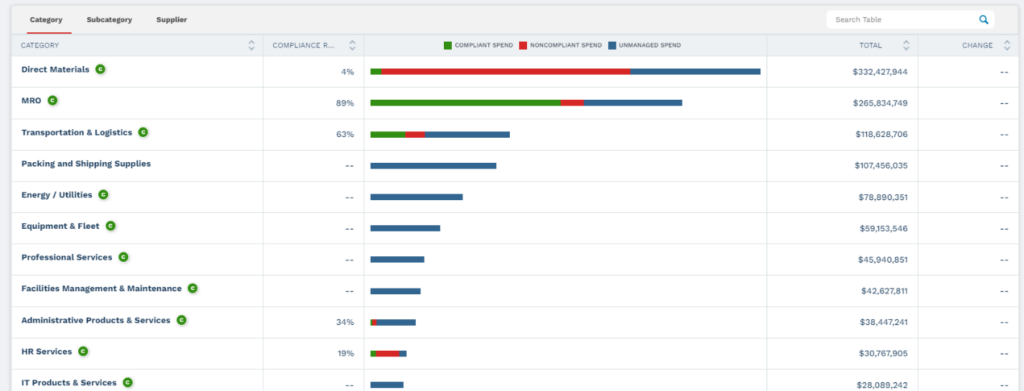
A category view of savings leakages in Spend Intelligence.
Portfolio company category management
Portfolio-wide initiatives are not the only way to capitalize on private equity procurement. Category management at both the GP and portfolio-company level holds massive margin potential because categories are where spend and cost centers develop.
Top-down category management at the portfolio level typically goes hand-in-hand with developing leveraged purchasing programs. But it also involves monitoring spend trends over time to boost efficiency and cut unnecessary spend wherever possible. You can do this yourself or equip consultants with a spend analytics platform for perpetual management.
To take your margin enhancements even further, you can equip procurement at each of your portfolio companies with the visibility needed to conduct ongoing category management. We built Spend Intelligence with this use case in mind. A single Spend Intelligence implementation provides each portfolio company with visibility into their own spend while relevant stakeholders at the portfolio level maintain full visibility.
Risk mitigation
Costs accumulate primarily in the daily operations of portfolio spend. However, risk in its various forms opens the door to events that can have massive financial implications, such as:
- Data breaches
- Human rights and modern slavery regulation violations
- ESG or data privacy regulation violations and resulting fines
- Press coverage that damages consumer relationships
Ensuring full visibility into your supply chain helps mitigate this risk and protects your company’s bottom line and reputation.
Evaluating portfolio supply chain risk
Like the other items on this list, you can’t impact what you can’t see. Comprehensive spend visibility is essential to finding and mitigating risk reliably. Our platform integrates with dozens of data enrichment partners to give teams a full-spectrum perspective on their opportunities and threats.
- Sustainability and Environmental Impact (Greenly, EcoVadis, Supplier.io)
- Diversity and Corporate Social Responsibility (Supplier.io)
- Cyber Risk (ApexAnalytics)
- Governance (e-Attestations)
- Financial Health (RapidRatings, Creditsafe, e-Attestations)
Using these integrations, firms can manage their portfolio holistically to cut costs and manage unnecessary risk.
Conclusion
Private equity procurement comes with several built-in levers that, when pulled, can drive significant EBITDA enhancement. For PE firms, effective procurement optimization relies on the ability to view spend comprehensively across your entire portfolio. Without this portfolio spend visibility, operating partners and consultants are left using their intuition and a small slice of the overall data to make decisions that have a minimal impact on spend at best and actively raise it in unforeseen ways at worst.
Whether you want to create a centralized purchasing program with internal procurement teams or engage a consultancy, our experience analyzing $8+ trillion of spend for 500+ organizations and 20+ GPs, positions SpendHQ as the ideal partner for helping you build a sophisticated, coordinated procurement function.