



It’s no secret that Procurement and Finance have different perspectives on spending. While both departments are focused on keeping organizational spend under management, that goal looks quite different for each, both in practice and in philosophy, especially when evaluating total spend and long-term value.
This can lead to frustration and miscommunication on both sides. For Procurement, there’s nothing more exasperating than Finance seeing a cost increase where Procurement sees a successful negotiation that reduces future spending costs. And from Finance’s perspective, Procurement never seems to have holistic data or transparent processes to clearly explain how addressable spending decisions affect the broader business.
However, ESG, inflation, and complex supply chains have forced the two departments to become more interconnected than ever. To capitalize on addressable spend opportunities and maximize their impact in today’s economy, Procurement leaders must learn how to adjust to these changes and communicate with Finance using a shared understanding of addressable expenditure and impactable spend across the company’s spending landscape.
Thankfully, after decades of working in and with Procurement teams all over the world, we’ve learned a thing or two about bridging this gap. Here are four ways you can build an iron-clad relationship with your Finance Department.
What is addressable spend?
Addressable spend refers to the portion of a company’s total spend that the procurement functions can manage, negotiate, or strategically optimize to better control costs. Also known as impactable spend, it represents the areas of spending where Procurement has the greatest ability to influence outcomes through informed procurement activity and aligned procurement strategy.
Understanding why addressable spend important requires context. Not all company spending can be influenced by Procurement. Some categories fall into non addressable spend, such as regulated costs, fixed utilities, or mandatory fees.
Addressable spend focuses on the remaining categories where Procurement can drive meaningful value by addressing:
- Contract opportunities
- Tail spend
- Maverick buying
- Price increases
- Subcategories without preferred suppliers
How to Calculate Addressable Spend
Calculating addressable spend starts by reviewing your organization’s total spend and breaking it down by spend category. Procurement teams assess which categories can be actively influenced through sourcing, negotiation, or supplier management and which fall outside their control.
Addressable spend typically includes indirect spend managed through indirect procurement, where Procurement has flexibility to influence suppliers, pricing, or demand. These areas often reveal opportunities hidden within tail spend, maverick spending, and inconsistent spending patterns across the organization.
In contrast, non addressable spend includes regulated costs, fixed fees, and other expenditures that cannot be negotiated or optimized in the near term. Excluding these categories helps Procurement set realistic expectations and focus effort where it can drive meaningful impact.
With a clear view of what is and is not addressable, teams can move from classification to action and begin identifying the highest-value opportunities.
Identifying Addressable Spend Opportunities
1. Filter everything through your organization’s goals
Because Finance usually sits near the top of the organization, the best way to get the team on your side is to look for addressable spend opportunities that directly contribute to executive priorities. If your organization is dedicated to increasing sustainability, focus on identifying suppliers with effective carbon reduction programs, even if it comes at the expense of a cost savings.
However, if the business is looking for cost reductions in a specific category, make that a priority zero. Identify contract opportunities, root out maverick spend, and propose key efficiency improvements before tackling other initiatives. By impacting core business goals first, you’re sure to place your alignment with Finance on an upward track.
Objectives and key results (OKRs) are a great place to start. If your organization has clearly defined, easily-accessible OKRs, you can use them to guide your search for addressable spend opportunities. If your organization doesn’t have clear OKRs, schedule quarterly touchpoints with Finance leaders. During these meetings, you can sync on projects, compare outcomes, and discuss each other’s challenges.
Another way to align around goals is to set spend under management targets with Finance. Take time in your quarterly meetings to ask leaders what their financial goals are and then work together to create a specific, strategic procurement plan. Then maintain a progress tracker that everyone can see so that you can demonstrate a pattern of continuous improvement. If you can sync with Finance early and often, you’ll create a feedback loop that fosters the collaboration that will drive the business forward.
How to Identify Addressable Spend Opportunities
To identify high-impact opportunities, Procurement teams should focus on translating data into actionable insights that reveal where change will matter most:
- Analyze spend data to uncover savings opportunities tied to inefficient demand, pricing variability, or supplier overlap
- Prioritize initiatives that support cost reduction or cost saving goals without undermining strategic objectives
- Evaluate how proposed changes will improve cash flow and deliver sustainable cost savings over time
- Look for repeatable savings that can be scaled across categories, regions, or suppliers
- Target opportunities that increase operational efficiency while reinforcing alignment with Finance and executive priorities
Why This Matters to Finance
When addressable spend opportunities are clearly tied to business goals and supported by transparent data, Finance can quickly see the value Procurement is driving. This shared understanding reduces friction, builds trust, and creates a stronger foundation for collaboration as both teams work toward the same outcomes.
2. Model the data
As we’ve already discussed, sometimes Finance sees losses where Procurement sees wins. It’s possible to bridge this gap, but it’s crucial to present data in a way that’s easy to understand and grounded in clear analysis. The best way to do this is with visual representation supported by reliable spend data.
Let’s use a price increase negotiation as an example. If you negotiate a price increase from 30% down to 18%, you’ve saved the company a lot of money. But if you simply show the new numbers at the end of the quarter, Finance will wonder why you let an 18% increase happen, especially when reviewing overall spending trends.
Instead, model the data on a graph so you can show what you would have spent compared to what you actually spent. This type of spend analysis highlights changes in spending patterns and makes your financial impact easy to see. Using spend analytics and procurement analytics together helps Finance understand not just the outcome, but the decision-making behind it.

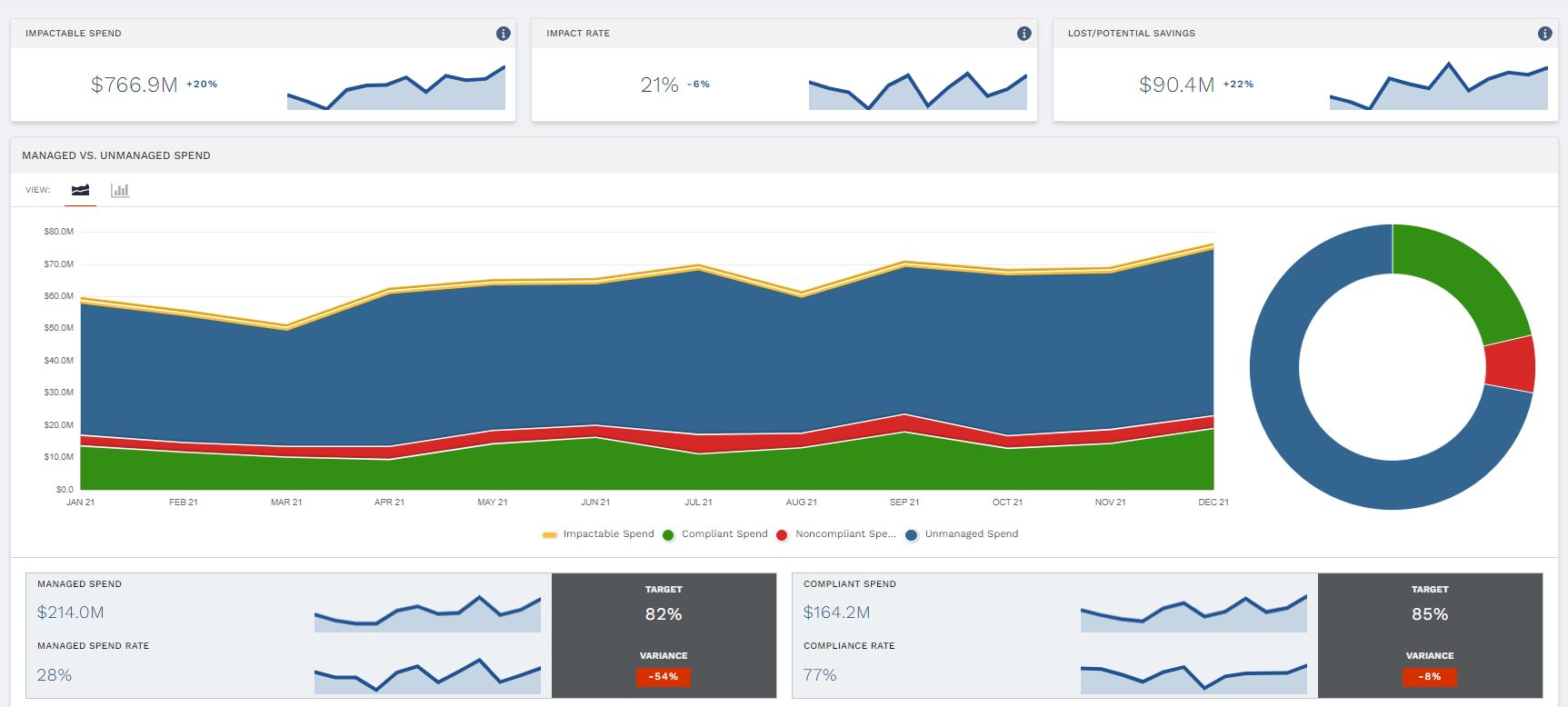
A strategic platform with intuitive visuals and strong spend visibility makes it easy to illustrate and communicate Procurement’s wins, turning raw analytics into actionable market intelligence that supports better project management and cross-functional alignment.
Another factor that you can’t forget to present is the cost avoidances that you’ve secured. Cost savings are usually easy to see because they positively impact cash flow statements. Cost avoidances are harder because financial statements don’t reflect expenses that you prevented. When it’s time for your touchpoints with Finance, make sure to prepare a chart or graph that shows what costs would have been without these cost avoidances. Otherwise, some of your most significant and impactful wins will fly under the radar.
3. Report ROI
Could your Finance Department quote how much money you’ve generated in savings for the organization this fiscal year? If not, then you probably have different views on how Procurement is handling addressable spend opportunities. However, if you consistently measure and report the results of your work, it becomes much easier to align on what success looks like and demonstrate the impact of the procurement function.
There are a few ways you can report your return on investment. The first is financial impact. If you negotiate a small parcel contract that delivers measurable cost savings, improves delivery time, and increases satisfaction, report all of those metrics together. Even initiatives that slightly increase costs can support stronger cash flow over time by improving reliability, resilience, or customer experience. Connecting outcomes to broader operational efficiency helps Finance understand the full value of Procurement decisions.
You should also report ROI when discussing the value of digital transformation. Modernizing your procurement function requires technological investment, but it also creates opportunities to improve procurement efficiency across sourcing, contracting, and supplier management. Clear reporting on both expected and realized returns helps justify investment and maintain executive support. Therefore, it’s important to have clear numbers on both the expected and realized return on your software investment.
Finally, some outcomes of procurement activity can be hard to measure financially—risk mitigation, vendor relationships, ESG initiatives, etc. You can report on uptime, quality improvements, financial incentives, and corporate reputation, but the best way to communicate results is to ask Finance what they want to know. Not only will this make sharing successes easier, but it will also go a long way toward cementing interdepartmental relationships.
4. Give Finance a window into your operations
As we discussed earlier, the inner workings of Procurement can be a mystery to outsiders. Without transparency, inflation and supply chain disruptions can make the function look inefficient and disorganized, even when teams are following established best practices. Letting this perception take root is the perfect way to resign Procurement to a tactical function.
Thankfully, the solution is simple: make Finance a partner by giving them a window into addressable spend and how you’re managing it. Show them your strategic Procurement vision by inviting them to your meetings, setting regular touchpoints, and consulting them on initiatives tied to strategic sourcing, category management, and effective contract management. But most importantly, give Finance direct visibility into your daily operations with a strategic procurement platform that blends spend intelligence and performance management.
Most importantly, give Finance direct visibility into your daily operations with a strategic procurement platform that brings together spend management, intelligence, and performance tracking. When Finance is only a click away from comparing the realities of organizational spend to your project pipeline, cultivating a collaborative relationship becomes easy. Finance leaders don’t have to wait for quarterly check-ins or request the latest versions of spreadsheets anymore. They can simply log in and get the data they need, whenever they need it. If that doesn’t create partnership, nothing will!
Of course, we could talk about this strategic platform all day; we invented it to do everything we’ve talked about here. But why not see for yourself how it can empower your relationship with Finance? Click below now to schedule a demo and get a personalized walkthrough of the tool that more than 500 businesses are using to transform how they partner with their colleagues in Finance.
Tools, Platforms, and Strategic Enablement
As Procurement teams scale, manual processes and disconnected systems make it difficult to maintain consistent spend management and deliver the level of spend visibility finance expects. Modern procurement platforms support strategic execution by enabling teams to:
- Centralize data to power accurate procurement analytics and reporting
- Translate raw spend data into actionable market intelligence for decision-making
- Align initiatives to a clear procurement strategy shared across Procurement and Finance
- Support more effective strategic sourcing through visibility into supplier performance and category-level trends
- Create a shared source of truth that improves collaboration, accountability, and execution
With the right tools in place, Procurement and Finance can move beyond reactive reporting and focus on driving sustained value together.
See how our platform can bring your strategy to life.
Get a DemoFrequently Asked Questions About Addressable Spend
Understanding why addressable spend important starts with clarity. It helps organizations focus effort on the portion of spend Procurement can actually influence, ensuring time and resources are directed toward initiatives that drive measurable value.
Non addressable spend includes costs that Procurement cannot reasonably control, such as regulated fees, taxes, or fixed utilities. These categories are typically excluded from savings targets to keep expectations realistic.
Most indirect spend is considered addressable because it often involves negotiable suppliers, fragmented purchasing, or demand variability. This makes it a common source of improvement initiatives.
Cost savings reflect realized financial impact, while savings opportunities represent potential value identified through analysis that has not yet been captured.
Spend analysis helps Procurement understand where money is going, identify patterns, and uncover areas for improvement. When paired with strong data, it becomes the foundation for prioritization and reporting.
Spend analytics provide ongoing visibility into performance, trends, and outcomes. They enable teams to monitor progress, validate impact, and continuously refine their approach to managing addressable spend.